PlaybookVulnerability management, SOC, red teams
Prepare for AI-powered attackers
Autonomous offensive agents now find and validate web vulnerabilities, and threat actors have used open-source agent frameworks in automated intrusions against many organisations at once. The practical effect for defenders is less time between disclosure and exploitation and more high-volume automated probing.
What practitioners converge on
- Shorten patch SLAs for exposed services. Prioritise internet-facing systems with known exploited or easily automatable flaws; AI agents compress the window after disclosure.
- Test yourself with the same class of tools. Authorised AI-assisted testing of your own estate shows what an automated attacker finds first.
- Detect the automation. Hunt for bursts of systematic recon, credential probing and exploitation attempts with unusual breadth or speed.
- Follow tools seen in attacks. Track offensive agent frameworks reported in real intrusions and the vendor reporting on their infrastructure and TTPs.
Checklist
5 stepsSaved in this browser. Track technique-level testing per system in Coverage.
Open-source stack
If you are evaluating vendors
AI red teaming and testing
- Does it test agents with tools, memory and MCP servers, or only a chat endpoint?
- How are findings scored: by business impact (data access, tool misuse) or by policy-violating text?
- Can we add our own attack datasets and app-specific policies, and re-run them as regression tests in CI?
- How does it test indirect prompt injection via documents, web pages and tool output?
AI SOC / agentic SOC
- On our historical alerts with known outcomes, what share of true and false positives did it classify correctly?
- Does every verdict show the evidence and queries it ran, so an analyst can verify it?
- Which actions can it take on its own (containment, account disable), and what approval gates exist?
- What read and write permissions does it need in our tools, and how are those credentials stored?
Detect and hunt 4
Techniques
References
Latest on this
-
Attackers' AI Agents Found a Zero-Day in Medical-Imaging Software and Gained Root Access
Amazon Threat Intelligence says suspected China-linked hackers used autonomous AI agents to find a zero-day in MONAI Label and gain root on a university server.
PatchUpgrade MONAI Label beyond 0.8.5 or restrict access to the server
-
European Commission Confirms AI-Driven Cyber-Attack Took Systems Offline
The European Commission confirmed an AI-driven cyber-attack took systems offline, with reports that attackers used ARTEX in the campaign.
HuntHunt for ARTEX-related activity in logs and review exposure of government-linked systems
-
Chinese state group developing automated attack tool for cyber espionage, Google says
Google reports threat actors, including a Chinese state group, are building autonomous multi-agent offensive AI frameworks for multi-stage cyber espionage intrusions.
ReviewReview exposure to autonomous AI-driven intrusion activity and monitor for named offensive frameworks
-
Google warns that fully automated cyberattacks have arrived and will get worse fast
Google GTIG says it observed an AI framework called exploit_agent, found on an exposed server, autonomously finding, patch-diffing, building and running exploits.
HuntHunt for exploit_agent artifacts on internet-facing servers
-
China-Nexus Actors Breach 10 Organizations in AI-Driven Attacks
China-nexus actors breached 10 organizations in autonomous AI-driven attacks against manufacturing, defense, and civil rights groups, using the Cairn framework.
ReviewReview exposure of manufacturing and defense assets to autonomous AI-driven intrusion
-
Google Finds Hackers Using AI Agents to Build and Run Exploits From Software Patches
Google reports threat actors are using autonomous multi-agent offensive frameworks such as ARTEX, CAIRN, CyberStrikeAI, and PentAGI to run multi-stage intrusions.
PatchApply the mitigations or fixed version described in the BerriAI advisory GHSA-wxxx-gvqv-xp7p.
-
Google warns that fully-automated AI attacks are coming soon
Google warns that threat actors are using agentic AI offensive frameworks to automate vulnerability discovery and exploitation at machine speed.
ReviewReview exposure to automated AI-driven exploitation of known and new flaws
-
FBI Highlights Growing Abuse of AI-Driven Pentesting Framework ARTEX
The FBI warns that threat actors are increasingly abusing the open-source AI pentesting tool ARTEX to run fast, large-scale intrusions worldwide.
HuntHunt for ARTEX-driven intrusion activity in logs and review exposed internet-facing systems
-
From Report to Tested Detection in Hours: The ARTEX Signature Pack
Researcher MalwareMustDie released an open detection pack for the ARTEX open-source AI pentest framework, used by criminals against real targets.
HuntLoad the ARTEX detection pack Sigma and KQL rules into SIEM and hunt for activity
-
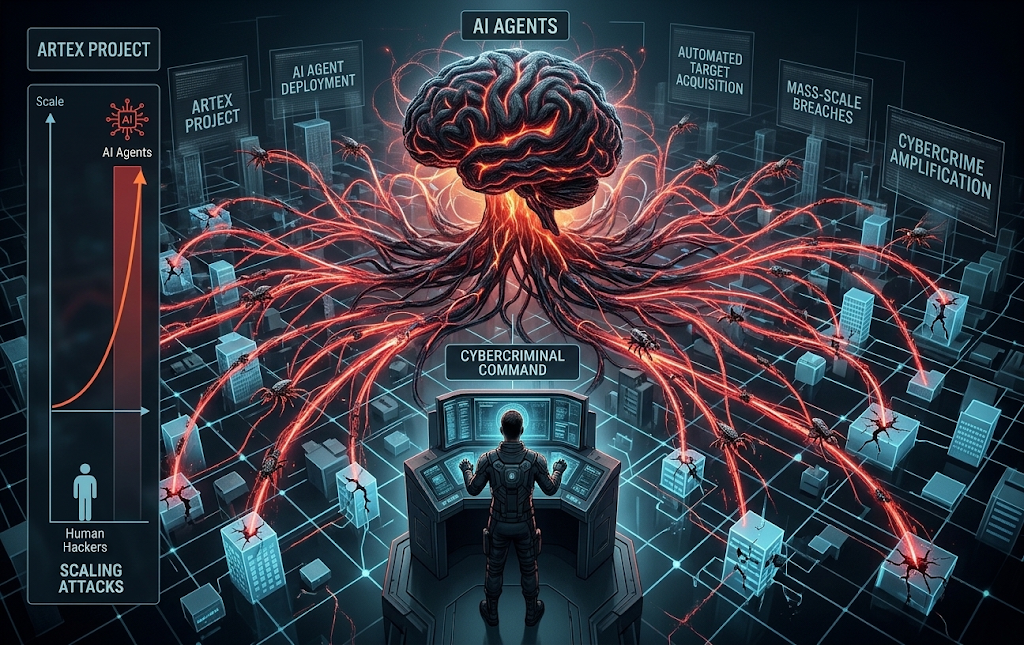
ARTEX: How Cybercriminals Use AI Agents to Scale Their Attacks
Amazon reports criminals running offensive campaigns with ARTEX, an open-source agentic AI pentesting framework, including credential theft and deepfake ID bypass tests.
HuntHunt for ARTEX agent requests to LLM-style API endpoints in proxy and API gateway logs







Reviewed 2026-11-09 · tools and news update automatically